Why Is Curling an Olympic Sport? History, Rules and Recognition
Curling is an Olympic sport because it meets the International Olympic Committee’s standards for organized international competition and demands much more than simply sliding stones across ice. Players need accuracy, balance, strength, communication, tactical judgment and the ability to perform under pressure.
The sport has a long international history, a recognized governing structure and competitions for both men and women. Curling returned to the Winter Olympics as an official medal sport in 1998 and has remained part of every Winter Games since then.
How curling became an Olympic sport
Curling has deep roots in Scotland, where people played versions of the game on frozen ponds centuries ago. The sport spread internationally as clubs, national associations and formal competitions developed.
Curling first appeared at the 1924 Winter Olympics in Chamonix. Its Olympic status was not consistent afterward: it was included as a demonstration sport at the 1932 Winter Games and later appeared in other demonstration events. The modern Olympic curling tournament was officially established at the 1998 Winter Olympics in Nagano, Japan.
The sport’s return reflected the growth of international curling and the work of its governing bodies. The World Curling Federation oversees international competition, while national teams qualify through structured events and rankings. This organization gives Olympic curling consistent rules, officiating and qualification standards.
What makes curling suitable for the Olympics?
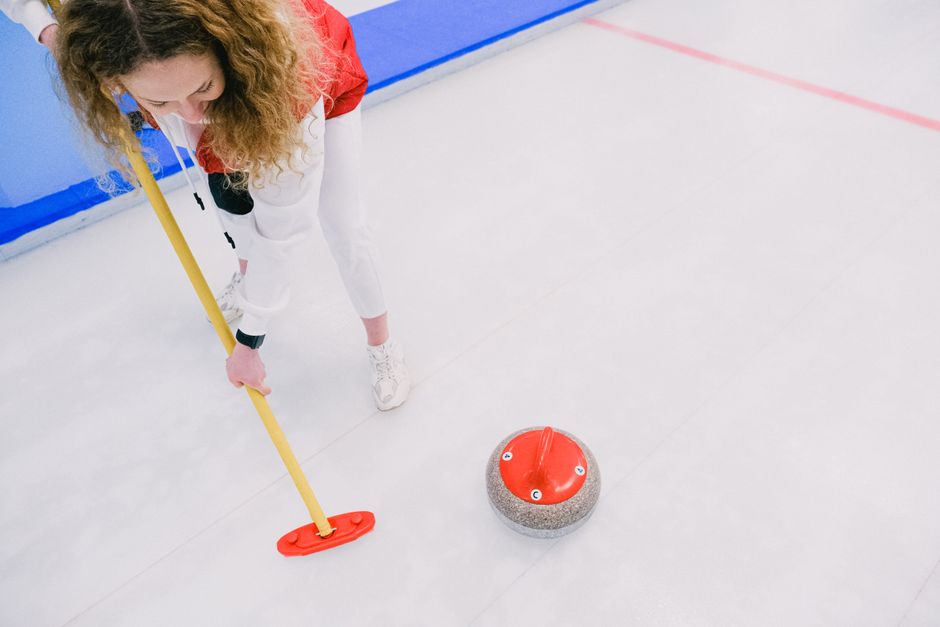
Olympic curling is a demanding team sport built around controlled execution. A player delivers a heavy granite stone toward a target, known as the house. Teammates can sweep the ice in front of the stone to influence its speed and direction. Small changes in the release, ice conditions or sweeping can decide which stone finishes closest to the centre.
- Precision: Players must control the stone’s speed, line and rotation with great consistency.
- Strategy: Teams decide where to place guards, when to remove opposing stones and how to create scoring chances.
- Teamwork: The skip communicates tactics while the other players execute shots and judge the stone’s path.
- Physical skill: Balance, flexibility, sweeping power and endurance all affect performance.
- Pressure management: A single final shot can determine the result of a close match.
These qualities answer a common misconception about curling: it is not a game based on luck or casual ice play. The sweeping is only one visible part of a sport that requires repeated technical practice and detailed knowledge of ice behaviour.
How Olympic curling is played
In traditional Olympic curling, two teams compete over a series of ends. Each team delivers eight stones per end, alternating with the opposition. After all stones have been played, only one team scores: it receives one point for every stone closer to the centre of the house than the opponent’s nearest stone.
The team with the most points after the scheduled ends wins. A match can also be decided in an extra end if the score is tied. Men’s and women’s curling use the same basic format, while mixed doubles curling uses two players per team and a shorter game structure.
Olympic curling now includes men’s, women’s and mixed doubles competitions. Mixed doubles helped broaden the event by placing men and women together on each team and introducing different tactical possibilities.
Why curling remains popular at the Winter Olympics
Curling is easy to follow at a basic level: teams try to place stones closer to the centre of the target than their opponents. Its deeper strategy gives experienced viewers more to analyze, including angles, defensive shots, deliberate misses and the value of keeping the final stone of an end.
The sport also offers a different kind of Olympic competition. Success depends less on speed over a fixed distance and more on accuracy, patience, communication and decision-making. That combination creates close matches in which the lead can change during the final shots.
Frequently asked questions
Was curling always an official Olympic sport?
No. Curling was part of the 1924 Winter Olympics and appeared in demonstration events before becoming an official medal sport at the 1998 Winter Olympics.
Is curling physically demanding?
Yes. Players repeatedly lunge to deliver stones, sweep forcefully and maintain balance on ice. Matches can last for several hours, so concentration and endurance are also essential.
Why do curlers sweep the ice?
Sweeping slightly warms and smooths the ice surface, allowing the stone to travel farther and curl less. Skilled sweeping can help a team control the final position of a stone.
Why is curling called a sport if it moves slowly?
Speed is not the only measure of athletic performance. Curling requires technical control, physical effort, tactical planning, coordination and competitive skill, which are the reasons it is recognized as a sport and included in the Olympic program.