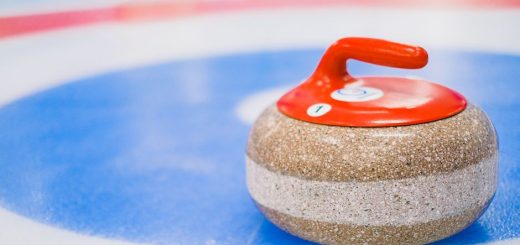
What Is the House in Curling? The Target, Rings and Scoring Area Explained
The house in curling is the circular target painted at each end of the sheet. Teams try to deliver stones into this area and position them as close as possible to the centre, known as the button. The house is both a scoring area and the main reference point for much of the tactical play.
Understanding the house helps explain why curlers use terms such as the button, four-foot, eight-foot, twelve-foot, tee line and guards. It also clears up a common misconception: a stone does not have to be completely inside the outer ring to count.
What the curling house looks like
A curling house consists of several concentric circles. From the outside inward, these are usually called the twelve-foot, eight-foot and four-foot circles. The small central circle is the button, which is located at the intersection of the centre line and the tee line.
- Twelve-foot circle: the outermost scoring ring and the boundary of the house.
- Eight-foot circle: the next ring toward the centre.
- Four-foot circle: the inner scoring ring, often a valuable area for positioning stones.
- Button: the centre of the house and the point teams generally want to approach most closely.
The rings show distance from the button, but they do not assign fixed points by themselves. A stone in the four-foot is not automatically worth more than one in the twelve-foot. Scoring depends on which team has the stones closest to the button after all stones in the end have come to rest.
How the house determines scoring
At the conclusion of an end, officials or players determine which stone is closest to the button. That stone’s team scores one point. The same team then receives one additional point for every other stone that is closer to the button than the opponent’s nearest stone.
For example, if Team A has three stones in the house but Team B has the closest stone, Team A scores nothing. If Team A has the closest stone and its second-closest stone is still nearer to the button than Team B’s closest stone, Team A scores two points.
A stone only needs part of its playing surface to be inside the outer edge of the twelve-foot circle to qualify as being in the house. Stones that finish entirely outside that boundary cannot score, although they may still have tactical value as guards or blockers.
If neither team has a stone in the house at the end of the play, the end is blank and no points are awarded. The hammer, meaning the last-stone advantage, normally remains with the team that had it for the blank end, depending on the competition’s rules.
Why the button matters
The button is the centre of the curling house and provides the most direct reference point for measuring shot success. A stone touching the button is not automatically guaranteed to score, because an opponent may place another stone closer or remove it with a takeout.
Teams often choose between placing a stone in front of the button, drawing it into the house, or attempting to remove an opponent’s stone. A stone directly in front of the button can be difficult to hit cleanly and may protect a scoring stone behind it. This is why the best shot is not always the one that finishes closest to the centre immediately.
The tee line runs across the house through the button. It divides the house into front and back sections and is also used when describing shots, such as a front-of-the-button draw or a back-ring stone. The line itself is not another scoring ring.
House stones, guards and the free guard zone
A stone in the house is often called a house stone or a scoring stone. A stone that stops in front of the house, before the tee line and outside the twelve-foot circle, is generally called a guard. Guards can block a direct path to the button or protect a stone already in the house.
The free guard zone rule limits when teams can remove certain guards. Under the widely used five-rock rule, during the early part of an end, the first five delivered stones cannot normally be removed from play if they are in the free guard zone. The exact application can vary by competition, so the event’s rulebook takes priority.
This rule creates a distinction between the house and the area in front of it. The house is where stones can score, while the free guard zone is strategically important because stones there can influence access to the house without yet being scoring stones.
How sweeping affects stones near the house
Sweeping does not push a stone directly toward the button. Brush contact can reduce friction between the stone and the ice, allowing it to travel farther and usually curl less. Sweepers therefore help the skip and thrower manage whether a stone reaches the house, stops short, or moves past a target.
Near the house, small differences in speed and line can change the result. A draw may stop in the four-foot, finish behind the tee line, or roll out of the house. A takeout may remove an opponent’s stone but also roll away from the centre, leaving the team with no immediate scoring stone.
Common misunderstandings about the curling house
The inner rings do not have fixed point values
Curling is not scored like a target sport in which the button automatically awards the highest number of points. The rings help players judge relative distance. The scoring team receives points based on how many stones are closer to the button than the opponent’s closest stone.
The whole stone does not need to be inside the house
Only part of the stone must reach the outer boundary for it to remain in the house. Because the stone is wider than the painted rings, players often use a measuring device when the difference between stones is too small to judge visually.
The house is not the entire playable area
Shots can be deliberately played outside the house. Guards, promoted guards, runbacks and other positional stones may be essential to creating a scoring chance later in the end. A stone outside the house may therefore be tactically useful even though it cannot score at that moment.
Frequently asked questions about the house in curling
What is the target in curling called?
The target is called the house. Its centre is called the button, and the surrounding rings are commonly identified by their distances from the centre.
How many points is the button worth in curling?
The button does not have a fixed standalone value. The team with the stone closest to the button scores at least one point, provided that stone is in the house. Additional points are awarded for other stones from the same team that are closer than the opponent’s nearest stone.
Can a stone outside the house score?
No. A stone must have part of its playing surface inside the outer edge of the twelve-foot circle to be eligible to score. It may still function as a guard or blocker outside the house.
Why do curlers sometimes aim away from the button?
A direct route to the button may be blocked, or a team may be trying to place a guard, freeze behind another stone, or create a later takeout angle. Curling strategy is based on the position of all stones, not only the distance of one stone from the centre.