Skills in Swimming: The Core Techniques Every Swimmer Develops
Swimming skill is more than the ability to move through water. It is a combination of water confidence, breathing control, body position, propulsion, coordination, and safety awareness. These abilities support every swimming stroke, from freestyle and backstroke to breaststroke and butterfly, while also helping swimmers conserve energy and respond calmly in difficult situations.
What are the main skills in swimming?
The most useful way to understand swimming ability is to divide it into connected skill areas. A swimmer may have strong arm technique but still struggle if breathing disrupts body position. Similarly, good fitness cannot fully compensate for poor balance or inefficient movement.
Water orientation and confidence
Water orientation is the ability to stay calm, change position, and understand how the body behaves when supported by water. It includes entering and exiting safely, submerging the face, floating on the front and back, rolling from one position to another, and returning to a stable posture.
These basic water skills matter because panic often causes unnecessary movements, breath-holding, and rapid fatigue. A swimmer who can float, breathe, and regain balance has a stronger foundation for learning formal strokes and handling unexpected situations.
Breathing control
Breathing in swimming is closely linked to rhythm. Swimmers generally inhale when the mouth is clear of the water and exhale while the face is submerged. In freestyle, this usually means turning the head to the side rather than lifting it forward. In breaststroke and butterfly, breathing is coordinated with the arm pull and body rise.
Controlled exhalation prevents the swimmer from holding the breath for too long. It also reduces interruptions to stroke timing. Bilateral breathing in freestyle—breathing to both sides—can improve awareness and help swimmers adapt to different race conditions, although some swimmers may use a different pattern for speed or comfort.
Body position and balance
Efficient swimmers maintain a streamlined position that reduces drag. In front crawl and backstroke, the head, hips, and legs should remain close to the surface, with the body extended along its direction of travel. Looking too far forward, lifting the head, or allowing the hips to sink increases resistance.
Balance is not identical in every stroke. Breaststroke and butterfly use deliberate changes in body position, while freestyle depends more heavily on a long, stable line with controlled rotation. Learning to relax the neck and keep the core engaged can improve alignment without creating unnecessary muscular tension.
Propulsion and stroke mechanics
Propulsion comes from coordinated movements of the arms, legs, and torso. The arms usually provide a large share of forward movement, but the legs help maintain body position, support timing, and contribute to speed. The most effective movement is not simply the hardest movement; it directs force backward while limiting resistance in other directions.
Freestyle requires a high-elbow recovery, an effective underwater catch, and a steady flutter kick. Backstroke uses alternating arm actions while the body rotates around its long axis. Breaststroke depends on the timing of the pull, breath, recovery, and whip kick. Butterfly combines simultaneous arm recovery with a two-beat undulating dolphin kick. Each stroke therefore requires different coordination, even though all rely on balance and controlled breathing.
Coordination and timing
Stroke coordination determines whether separate movements work as one efficient action. In freestyle, arm turnover, body rotation, kick, and breathing must fit into a repeatable rhythm. In breaststroke, the glide phase is especially significant because beginning the next pull too early can eliminate the benefit of the kick. Butterfly requires the hips and legs to follow the wave-like movement of the torso rather than relying only on the knees.
Good timing can make a moderate amount of strength more effective. Poor timing often produces a faster feeling of effort without a proportional increase in speed.
Technical skills for different swimming strokes
General water skills transfer across strokes, but each technique has distinct demands. Understanding those differences helps swimmers identify whether a problem involves strength, balance, breathing, or stroke timing.
Freestyle and front crawl
- Maintain a long body line with the head in a neutral position.
- Rotate the body from the hips and shoulders rather than lifting the head to breathe.
- Enter the hand in line with the shoulder and establish a firm underwater catch.
- Use a relaxed recovery and a kick that supports alignment without excessive splashing.
- Coordinate breathing with the stroke cycle so that the body does not pause during inhalation.
Common freestyle errors include crossing the hands over the centre line, pushing water downward instead of backward, and holding the breath underwater. These mistakes increase drag or interrupt propulsion.
Backstroke
Backstroke depends on body awareness because the swimmer cannot see the direction of travel. The hips should remain near the surface, the head should stay relatively still, and the shoulders and hips should rotate together. The arms alternate continuously, with the hand entering the water in line with the shoulder rather than across the body.
A consistent backstroke kick helps keep the legs from sinking, but a large, tense kick can waste energy. Swimmers also need awareness of lane space, flags, walls, and other people in the pool.
Breaststroke
Breaststroke is defined by its timing. The arms pull, the body rises for the breath, the legs recover and kick, and the swimmer then extends into a brief glide. The kick should turn the feet outward before the legs drive water backward and finish together.
Because the stroke includes a glide, breaststroke is particularly sensitive to rushed movements. Pulling too deeply, recovering the legs too early, or lifting the head excessively can increase drag and reduce forward travel.
Butterfly
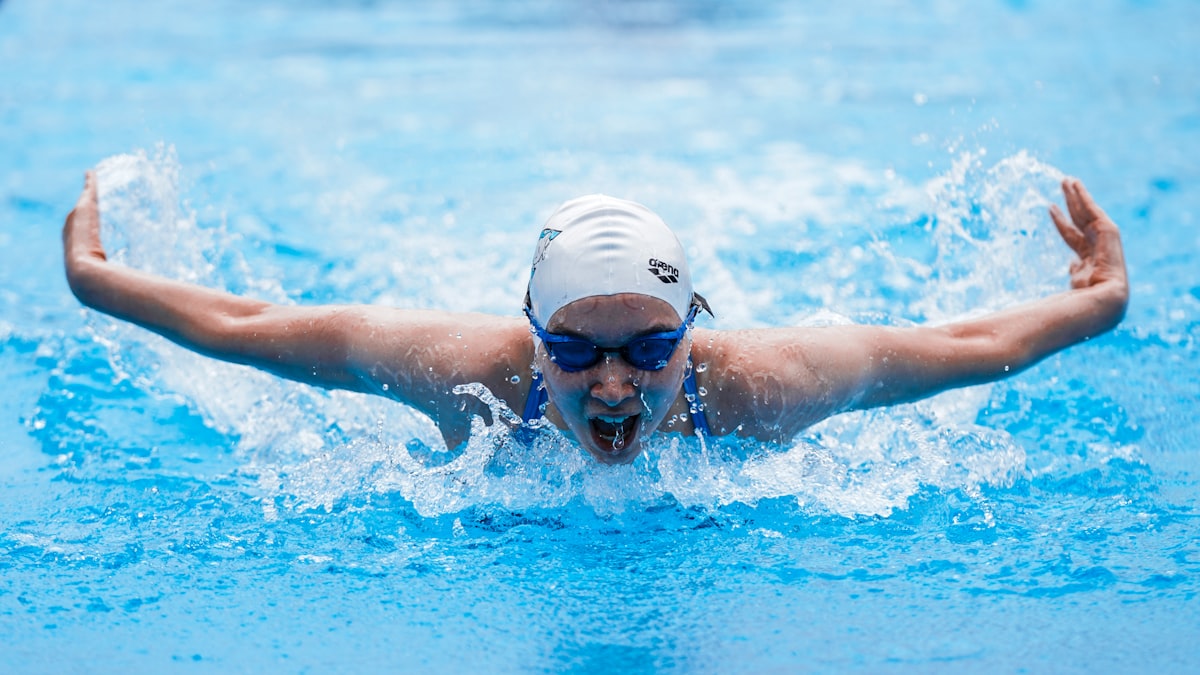
Butterfly requires simultaneous arm action, a coordinated dolphin kick, and wave-like body movement. The first kick helps support the catch and body line, while the second kick assists the arm recovery and forward momentum. The breathing action should be low and controlled rather than a high lift of the head.
This stroke places substantial demands on shoulder mobility, trunk control, and conditioning. Swimmers who lack the required technique may compensate with excessive lower-back movement or forceful arm recovery, increasing fatigue and potentially contributing to overuse problems.
Water safety and survival swimming skills
Swimming competence should include skills that are useful outside structured lap swimming. These include floating for rest, treading water, swimming a short distance while wearing appropriate clothing, turning onto the back to breathe, reaching or throwing assistance to another person, and exiting the water safely.
Treading water combines an upright body position with controlled leg and arm movements. It can be performed with several techniques, including an eggbeater kick, breaststroke-style leg action, or alternating sculling. The right choice depends on the swimmer’s strength, flexibility, clothing, and the time required to remain afloat.
Swimming ability does not remove environmental risks. Open water may involve currents, waves, cold temperatures, poor visibility, sudden depth changes, and distant shorelines. Children and inexperienced swimmers require close, active supervision, and no swimmer should rely solely on personal ability in place of appropriate safety measures.
Skills that improve swimming efficiency
Efficiency is the relationship between useful forward movement and the effort spent producing it. Streamlining after a push-off, reducing unnecessary head movement, improving the underwater catch, and controlling the kick can all reduce resistance. Turns and underwater phases also matter in pool swimming because they can account for a meaningful part of a session or race.
Sculling drills help swimmers feel pressure on the hands and forearms. Kick drills isolate leg timing, while single-arm drills can reveal problems with body rotation or breathing. These exercises are most useful when they address a specific technical fault rather than replacing normal swimming for an entire session.
Physical and mental abilities behind swimming performance
Swimming also depends on mobility, strength, aerobic endurance, speed, and coordination. Shoulder and ankle mobility influence the ability to hold effective positions, while trunk strength helps transfer force between the arms and legs. Aerobic fitness supports sustained swimming, whereas repeated sprint ability matters more for short races or interval training.
Relaxation is a technical skill as well as a mental one. Excessive tension can shorten the stroke, restrict breathing, and increase energy use. Confidence should be built through controlled exposure to skills at an appropriate depth and pace, not by repeatedly placing a swimmer in situations beyond their ability.
Common misconceptions about swimming skills
One misconception is that swimming faster always means moving the arms or legs faster. Speed can improve through better alignment, stronger propulsion, and reduced drag without a dramatic increase in stroke rate. Another misconception is that endurance alone makes someone a safe swimmer. A person may swim several lengths in a pool yet struggle with cold water, waves, clothing, or fatigue in open water.
It is also inaccurate to treat all strokes as interchangeable. A swimmer who performs freestyle well may still need to learn different breathing patterns, timing, and body positions for breaststroke, backstroke, or butterfly. Technique should be evaluated within the specific stroke and situation being practiced.