
Top 10 Best Stadiums in Africa
Choosing the most beautiful stadium in Africa is necessarily subjective. A venue may stand out because of its architecture, its relationship with the surrounding city, its history, or the atmosphere created by supporters on match day. Capacity alone does not determine visual quality.
This ranking focuses on stadiums that combine distinctive design with strong sporting identity. Most are football venues, although several also host athletics, concerts and national events. Conditions can change after renovations, and the experience for visitors depends on access, maintenance and whether a major fixture is taking place.
How Africa’s best-looking stadiums were assessed
The comparison considers five factors: architectural character, setting, spectator experience, historical importance and flexibility of use. A modern roof or unusual exterior can make a stadium memorable, but practical details also matter. Sightlines, circulation, shade, accessibility and the quality of the surrounding public space influence how successfully a stadium works.
The list is not an official award. It is a reasoned selection of prominent African stadiums that are regularly mentioned for their appearance, atmosphere or architectural significance.
Top 10 most beautiful stadiums in Africa
1. Cape Town Stadium — Cape Town, South Africa
Cape Town Stadium is often considered the strongest all-round candidate for Africa’s most beautiful stadium. Its white exterior and cable-supported roof create a clean, contemporary profile, while Table Mountain and the Atlantic coastline provide an exceptional setting.
The stadium was built for the 2010 FIFA World Cup and sits between the city centre and the Atlantic Seaboard. That location gives spectators a visual experience that few large football grounds can match. Its appearance changes with the light and weather, from a bright landmark on clear days to a dramatic structure against the mountain and cloud.
Its main limitation is that its beauty depends partly on the surrounding landscape. The architecture is carefully designed, but the setting does much of the visual work.
2. Moses Mabhida Stadium — Durban, South Africa
Moses Mabhida Stadium is defined by its enormous arch, which rises above the bowl and symbolises unity. The arch is not merely decorative: it forms a major structural element supporting the roof. This gives the venue a recognisable silhouette from across Durban.
The stadium’s open, lightweight appearance contrasts with the dense concrete forms associated with many older arenas. It also benefits from its position near the Indian Ocean and Durban’s beachfront. Visitors can experience the venue through sport, events and sightseeing attractions connected with the arch.
Its design is especially successful at city scale. Even from outside the ground, the arch makes the stadium immediately identifiable.
3. FNB Stadium — Johannesburg, South Africa
FNB Stadium, commonly known as Soccer City, has one of the most distinctive exteriors on the continent. Its façade was inspired by an African calabash, producing a patterned, earthen-coloured shell around the main bowl.
The design gives the stadium a strong connection to African visual traditions without copying a single historic building. Inside, the large bowl is designed for major football occasions, and the venue’s history includes the opening ceremony and final of the 2010 World Cup as well as important South African national-team matches.
FNB Stadium is not as closely integrated with a dramatic natural landscape as Cape Town Stadium or Moses Mabhida Stadium. Its strength is symbolic architecture: it looks like a national landmark rather than a generic sports arena.
4. Nelson Mandela Bay Stadium — Gqeberha, South Africa
Nelson Mandela Bay Stadium is recognisable for its petal-like roof structures, which resemble flowers or sails around the bowl. The design gives the stadium a lighter and more sculptural appearance than many large enclosed venues.
The stadium was constructed for the 2010 World Cup and is positioned close to the coast in Gqeberha. The repeated roof elements create a strong visual rhythm, while the white exterior helps the venue stand out against the surrounding urban landscape.
Its appearance is particularly effective from a distance, where the roof seems to float above the seating bowl. The complex shape also makes maintenance and long-term upkeep more demanding than a simpler roof design.
5. Mbombela Stadium — Mbombela, South Africa
Mbombela Stadium is one of Africa’s most playful football venues. Its exterior incorporates giraffe-inspired columns and patterns, reflecting the wildlife and landscape associated with Mpumalanga.
The stadium was built for the 2010 World Cup and has a more compact character than some of the continent’s largest arenas. Its design is memorable because it uses local visual references in a direct, accessible way rather than relying only on abstract geometry.
The result is less formal than the architecture of Cape Town Stadium or FNB Stadium. That is also its appeal: the venue feels connected to the region and provides a clear identity for a city that is not usually associated with the world’s largest sporting events.
6. Stade d’Agadir — Agadir, Morocco
Stade d’Agadir is a modern Moroccan stadium with a broad, angular form and a large roof structure that gives it a strong contemporary presence. It is also known as the Adrar Stadium, referring to the surrounding area.
The venue’s design reflects the clean lines and open geometry often associated with newer Moroccan sports infrastructure. Its setting near Agadir makes it part of a city shaped by coastal tourism, wide roads and modern redevelopment.
Unlike stadiums whose character depends on a historic football culture, Stade d’Agadir is attractive because of its modern construction and disciplined proportions. Its visual impact is strongest when the roof and exterior are viewed as a single architectural composition.
7. Stade de Marrakech — Marrakech, Morocco
Stade de Marrakech combines a large, modern football ground with visual cues associated with the city’s red and ochre architectural palette. The venue’s exterior and surrounding landscape give it a strong sense of place.
The stadium was opened in the early 2010s and has hosted football matches, athletics and other major events. Its wide bowl and substantial roof provide a clear, contemporary profile without competing with the historic architecture of central Marrakech.
Its appeal comes from balance rather than a single spectacular feature. The stadium looks modern while remaining visually compatible with the colour and character of the wider city.
8. Cairo International Stadium — Cairo, Egypt
Cairo International Stadium is older than most venues on this list, but its scale and sporting history make it an important part of Africa’s stadium landscape. The broad roof over the main stand and the expansive seating bowl give it the character of a major national arena.
The stadium has hosted Egyptian national-team matches, African competitions and large public events. Its appeal is therefore tied to atmosphere and historical significance as much as to contemporary architectural detail.
It is not the most experimental stadium in Africa, and parts of its design reflect an earlier era of sports construction. However, its monumental scale and location in one of the continent’s great football cities give it a presence that newer grounds do not automatically replicate.
9. Borg El Arab Stadium — Alexandria, Egypt
Borg El Arab Stadium is one of Africa’s largest football venues and has a powerful, monumental appearance. Its extensive stands and broad approach areas are designed for major national and international fixtures.
Located west of Alexandria, the stadium has a more open setting than the dense urban grounds of central Cairo. Its architecture is less delicate than that of the South African 2010 World Cup venues, but its size creates a sense of occasion that is difficult to ignore.
Its principal strength is scale. For supporters attending a major match, the large bowl can produce an impressive visual and acoustic experience, although the distance from Alexandria’s central districts can affect convenience.
10. Benjamin Mkapa National Stadium — Dar es Salaam, Tanzania
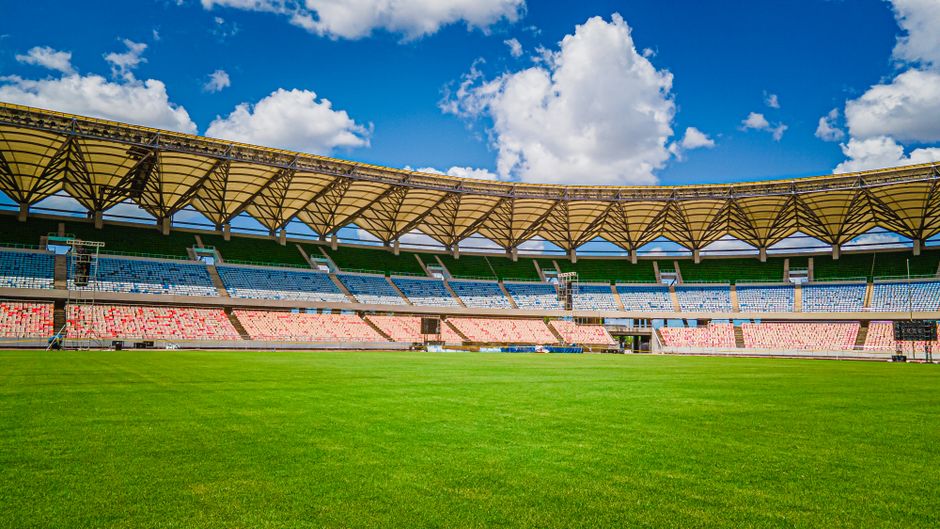
Benjamin Mkapa National Stadium is one of East Africa’s most prominent modern football venues. Its large roofed stands and symmetrical structure give it a polished appearance, while its importance to Tanzanian football adds cultural weight.
The stadium hosts national-team matches and major domestic fixtures in Dar es Salaam. Its design prioritises capacity, clear views and a strong external identity rather than highly unusual decorative features.
It earns a place on this list because visual quality is not limited to avant-garde architecture. A stadium can be attractive through proportion, order and the way it functions as a civic landmark.
Which stadium is the best overall?
Cape Town Stadium is the strongest choice if the criteria are visual setting, architectural elegance and visitor appeal. Moses Mabhida Stadium may be the better choice for a bold structural landmark, while FNB Stadium has the deepest symbolic connection with African football and major international events.
For fans who value local identity, Mbombela Stadium and Stade de Marrakech offer particularly clear regional character. For those who prefer monumental scale and match-day intensity, Borg El Arab and Cairo International Stadium are more compelling than their architectural simplicity might suggest.
Why stadium beauty is difficult to rank
Photographs often favour roofs, façades and mountain or coastal backdrops. A match-day visit reveals other factors: how quickly spectators enter, whether the concourses are comfortable, how well the roof protects the stands, and how easily the venue connects with public transport.
Age also matters. New stadiums usually have cleaner surfaces and more advanced facilities, but older venues can possess stronger sporting memories and a more distinctive supporter culture. A stadium’s beauty is therefore a combination of design, setting and use rather than a purely visual contest.
Africa’s best stadiums show several different approaches: landmark structures integrated with city skylines, arenas shaped by local landscapes, and practical national venues whose importance has grown through football history. That variety is what makes any top 10 ranking subjective, but it also makes the continent’s stadium architecture unusually diverse.