Serving in Volleyball: Rules, Types and Technique
Serving in volleyball starts every rally and gives a team its first chance to put pressure on the opponent. A good serve combines control, placement, and enough pace or movement to make the first pass difficult. Players can serve from different positions on the end line and choose a technique that matches their skill level and tactical plan.
What is a serve in volleyball?
A serve is the action that puts the ball into play. The server stands behind the end line and hits the ball over the net into the opposing team’s court. The rally begins once the ball crosses the net or is contacted by a receiving player.
Under standard indoor volleyball rules, the serving team earns the right to serve after winning a rally. Players rotate one position clockwise before the next serve. The player moving into the right-back position becomes the server. A team continues serving until the opponent wins the rally.
Volleyball serving rules
- The server must be in the service zone behind the end line at the moment of contact.
- The server may move freely within the service zone, but must not step on or beyond the end line before hitting the ball.
- The ball must be released or tossed before it is struck with one hand or any part of the arm.
- The server has one attempt to contact the ball in standard indoor volleyball.
- The serve must cross above the net and land inside the opponent’s court, unless it is touched by a receiving player first.
- A serve that touches the net can still be legal if it crosses the net and lands in the opponent’s court.
- The serving team must follow the correct rotation order. Serving out of rotation results in a rotational fault and a point for the other team.
Rules can differ slightly between indoor, beach, school, and recreational volleyball. Beach volleyball teams have two players and rotate service order differently, while local competitions may apply specific rules about screening, substitutions, or service attempts.
Types of volleyball serves
Underhand serve
The underhand serve is often the first serve players learn. The ball is held in the non-dominant hand while the serving hand swings upward to contact the lower part of the ball. It is easier to control than other serves and is useful for beginners, young players, or anyone rebuilding consistency.
Overhand serve
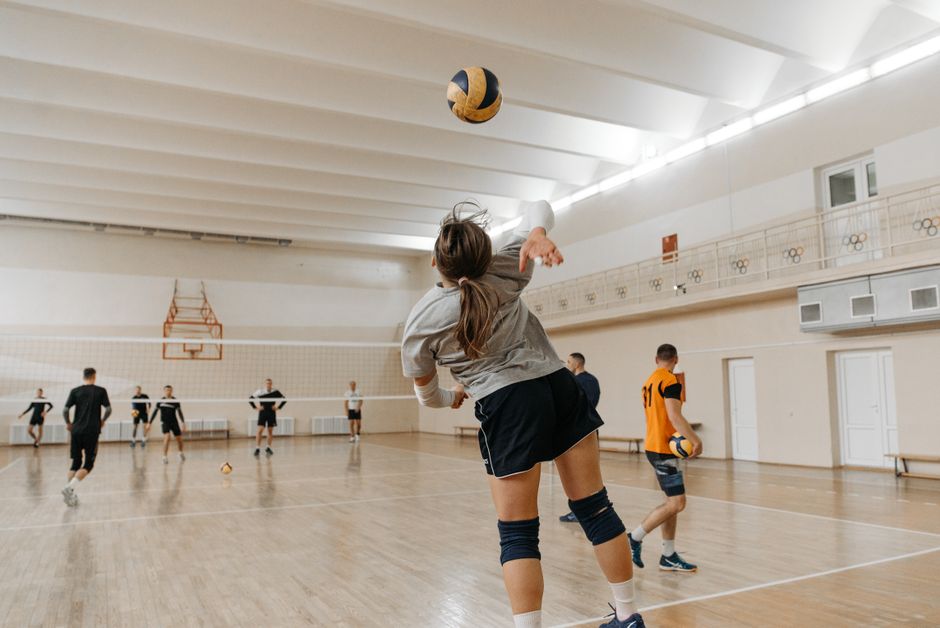
An overhand serve gives the player more options for speed and placement. The server tosses the ball above the hitting shoulder, draws the arm back, and strikes the center or slightly lower part of the ball with an open hand. A controlled overhand serve is a strong foundation for more advanced techniques.
Float serve
A float serve travels with little or no spin. The server contacts the middle of the ball with a firm hand and a short, controlled swing. Because the ball does not rotate consistently, its flight can shift or dip unexpectedly. A standing float serve is common in competitive volleyball because it can be accurate while still challenging to pass.
Jump float serve
The jump float adds a small approach and jump to the float-serve motion. The server contacts the ball at a higher point, which can create a steeper trajectory and reduce the receiver’s reaction time. Timing the toss and keeping the contact clean are more important than jumping high.
Topspin serve
A topspin serve uses a brushing action from low to high across the back of the ball. Forward rotation makes the ball drop more quickly, allowing the server to hit with greater speed while keeping the serve in the court. The jump topspin serve is powerful but requires advanced control, timing, and strength.
Basic serving technique
- Start in balance: Stand with the foot opposite your hitting hand slightly forward. Keep your shoulders relaxed and face the target area.
- Use a consistent toss: Toss the ball in front of the hitting shoulder and high enough to allow a full, comfortable swing. An inconsistent toss usually creates an inconsistent serve.
- Reach with the hitting arm: Draw the elbow back, keep the hand open, and contact the ball at a comfortable height rather than reaching too far behind the body.
- Strike the correct area: Contact the center of the ball for a stable serve. For a float serve, keep the wrist firm and avoid brushing around the sides.
- Transfer your weight: Move from the back foot toward the target as the arm swings forward. The motion should be smooth instead of forced.
- Finish under control: Allow the arm to follow through toward the target and recover quickly for the next defensive action.
Players should practice the toss separately before adding a full swing. A repeatable toss makes it easier to control contact point, direction, and pace.
Where to serve on the court
Serving directly at a player is not always the best choice. The target should reflect the opponent’s passing ability, position, and movement. A serve can be directed deep toward a corner, short into the front of the receiving formation, or into the space between two passers.
- Deep corner: Makes the passer move and can push them away from the net.
- Short zone: Forces a player to move forward and may disrupt an attacking approach.
- Seam between passers: Creates uncertainty about who should take the ball.
- Strong hitter: Serving toward an important attacker can limit their approach and reduce their options.
- Weak passer: Repeatedly testing a less reliable receiver can create pressure, although changing direction prevents the opponent from settling into a rhythm.
Serve placement should support the team’s defensive plan. For example, a deep serve may be useful when blockers and defenders are prepared for a high outside set, while a short serve can work when the opponent’s front-row players are slow to transition.
Common serving mistakes
Many service errors come from trying to generate power before developing control. Stepping on the end line, tossing the ball too far behind the body, and contacting the ball with a loose hand are frequent problems. Players also tend to aim at the net instead of choosing a clear target inside the court.
Another common mistake is changing the entire motion after one missed serve. Make one adjustment at a time: move the toss slightly forward, shorten the swing, improve the contact point, or reduce the power. This makes the cause of the error easier to identify.
How to improve serving consistency
Begin practice by choosing a large target area and completing a set of serves with the same routine. Once the ball regularly crosses the net and lands in play, make the target smaller. Track both successful serves and service errors rather than judging progress only by speed.
A useful volleyball serving drill is to divide the opponent’s court into zones. Serve several balls to each zone, then record which targets produce the best accuracy. Include pressure by setting a goal, such as completing a sequence of legal serves before changing targets. Practice both a reliable serve and a more aggressive option so you can select the right level of risk during a match.
Use video or feedback from a coach to check the toss, contact point, foot position, and follow-through. Consistent preparation matters as much as the final swing: take the same breath, visualise the target, and use the same pre-serve routine before every attempt.