Why Does a Curling Stone Curl? The Physics Behind the Curve
A curling stone can look almost motionless as it glides, yet its path gradually bends across the sheet. The curve is not caused by the stone being shaped like a ball, nor is it mainly a flying-disc effect. It comes from the interaction between the stone’s narrow running band, its rotation and the tiny bumps on the ice.
How rotation makes a curling stone curve
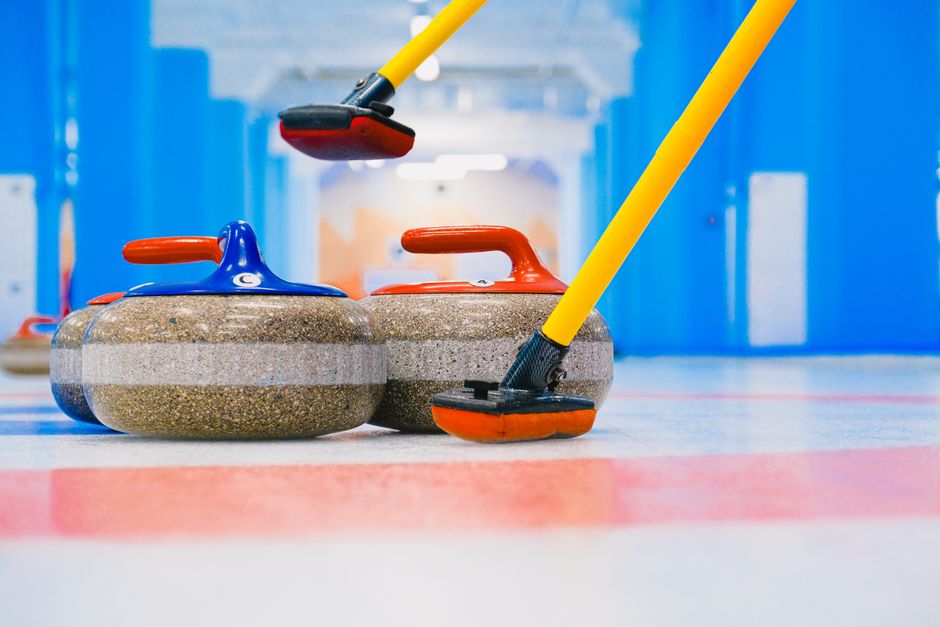
The bottom of a curling stone is not completely flat. It rests on a polished circular surface called the running band. Only this relatively narrow band touches the pebble ice, which is covered with small frozen droplets known as pebble.
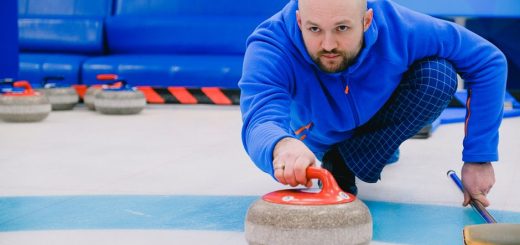
Before delivery, the player gives the stone a slow rotation. As the stone moves forward, different parts of the running band meet the ice at slightly different angles and speeds. The friction created by those contacts is not perfectly equal around the stone. That imbalance produces a small sideways force.
One contact point may initially push the stone slightly away from its eventual curve, while the changing friction around the running band gradually turns the stone in the direction of its rotation. A clockwise rotation, viewed from above behind the stone, produces a curl to the right; an anticlockwise rotation produces a curl to the left.
The effect is subtle. The stone does not suddenly veer sideways. Instead, thousands of tiny frictional interactions slowly alter its direction, so the curve becomes obvious only after the stone has travelled a significant distance.
The role of pebble ice and the running band
The phrase “curling stone friction” can be misleading because friction is not simply pulling the stone toward one side. The surface of the ice matters just as much as the stone’s rotation. Pebble creates a changing pattern of contact beneath the running band, and the stone’s passage can slightly alter that contact.
As the stone travels, the front and rear portions of the running band do not interact with the ice in exactly the same way. The leading part encounters fresh pebble, while the trailing part passes over ice that has already been compressed and rubbed. This difference helps generate the sideways force responsible for the curl.
The carefully prepared ice is therefore essential. A stone sliding on a perfectly smooth surface would behave differently, while worn, damaged or inconsistent pebble can make the path less predictable. Stone polish, running-band shape and the condition of the sheet all affect how much a curling stone curls.
Why a slower stone curls more
A delivered stone usually curls more as it loses speed. Early in the shot, its forward motion dominates and the sideways change is small. Later, the stone has more time for friction to alter its direction, so the curve becomes easier to see.
This is why a takeout shot, which is thrown firmly, may travel relatively straight before hitting its target. A draw shot delivered with less weight stays on the ice longer and can curl several feet. The amount of curl also depends on the rotation rate: too little rotation can produce an unstable path, while a controlled rotation gives the skip a more reliable line.
What sweeping does to the stone’s path
Sweeping does not push the stone directly toward the target. Sweepers brush the ice in front of the stone, warming and smoothing the upper surface of the pebble for a brief moment. This reduces resistance and allows the stone to travel farther.
Because the stone keeps more of its forward speed, sweeping usually delays the curl and makes the line straighter. A team can also sweep more on one side to influence the stone’s path, although the result depends on timing, pressure, ice conditions and the stone’s rotation.
The practical consequence is easy to see during a match: a stone that appears to be running wide can be held straighter with sweeping, while a stone left untouched may slow down and finish farther to one side.
Common explanations that miss the main point
The Magnus effect is sometimes used to explain why does a curling stone curl, but that comparison is not the best fit. The Magnus effect describes a spinning object moving through a fluid such as air. A curling stone is sliding across solid ice, and its sideways movement is mainly produced by friction at the running band and the textured ice surface.
The stone’s granite composition matters because it provides the required weight, hardness and durable polished surface, but granite alone does not make the stone curl. Rotation, the geometry of the running band and the condition of the pebble work together.
Frequently asked questions about curling stone curl
Does a curling stone curl in the direction it spins?
Yes. In normal play, the stone eventually curves in the direction of its rotation. A clockwise rotation curves to the right when viewed from behind the moving stone, while an anticlockwise rotation curves to the left.
Why does a curling stone not curl immediately?
The sideways force is small compared with the stone’s forward momentum. The curve develops progressively as friction acts over a longer distance and the stone slows.
Can sweeping make a stone curl more?
Ordinary sweeping reduces resistance, helps the stone travel farther and generally delays its curl. Sweeping on one side can also influence the line, but it does not replace the rotation that starts the curling motion.