Skills in Karate: The Techniques, Attributes, and Tactics Practitioners Develop
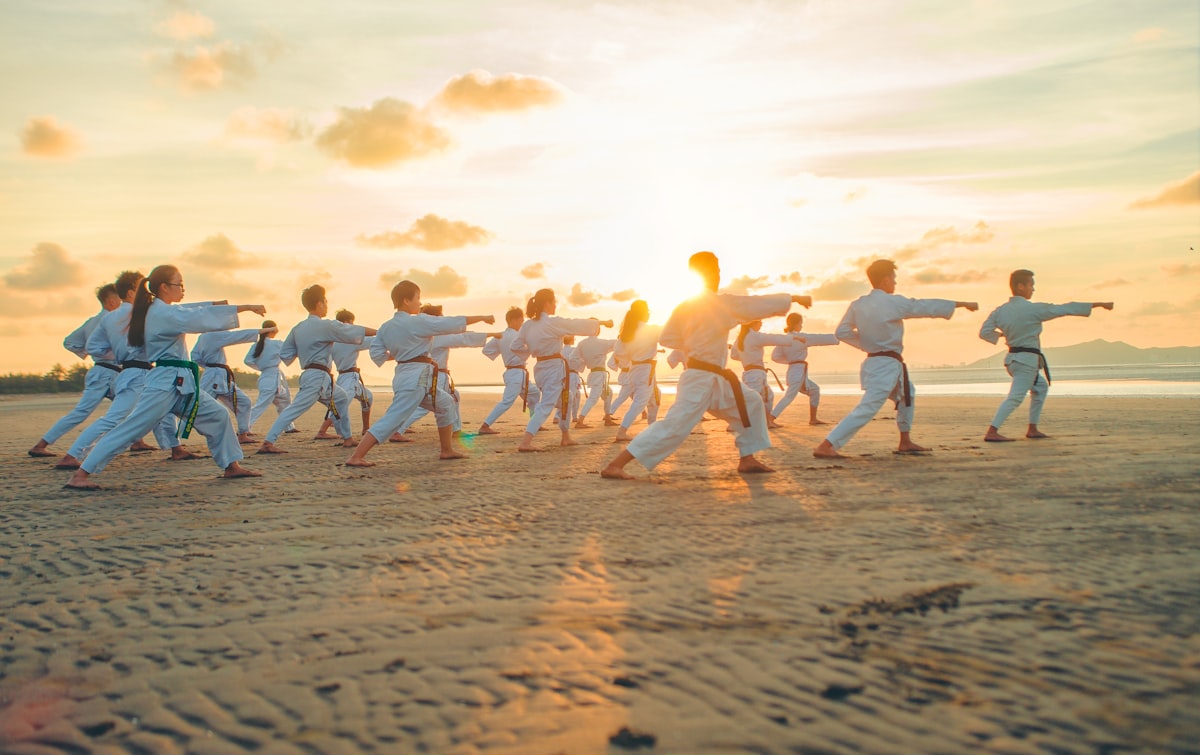
Skills in karate extend well beyond the ability to throw a punch or kick. Effective practice combines body positioning, striking mechanics, defensive movement, distance control, timing, balance, coordination, and disciplined decision-making. The exact emphasis varies between karate styles and training goals, but the underlying skills are closely connected: poor stance can weaken a technique, limited footwork can prevent accurate distance, and weak timing can make a technically correct attack ineffective.
Technical skills in karate
Karate technique is usually built from a small set of movements that can be combined in different sequences. Practitioners commonly train punches, kicks, blocks, evasions, stances, turns, and transitions between techniques. Correct form is not merely a visual standard. It helps the practitioner control force, maintain balance, recover quickly, and reduce unnecessary movement.
Stances and body alignment
Stances provide the base for movement and technique. Common karate stances include front stance, back stance, horse stance, and fighting stance, although names and details differ among organisations. A useful stance places the feet in a position that supports stability without making movement slow. The knees, hips, spine, and shoulders should work together rather than becoming rigid or misaligned.
A long, deep stance may help develop strength and positional awareness during basic training, but it is not always the best position for free movement. In kumite, practitioners usually need a more mobile posture that allows rapid advances, retreats, angle changes, and defensive reactions. This difference explains why traditional kihon positions and sparring positions may look distinct while serving related purposes.
Punching and hand techniques
Karate hand techniques include straight punches, reverse punches, hooks, backfists, knife-hand strikes, and other open-hand actions. A straight punch depends on more than arm speed. The movement normally involves coordinated rotation or extension through the legs, hips, trunk, shoulder, and arm, followed by a controlled return to guard.
Accuracy and structure matter as much as force. The striking surface should be appropriate to the technique, the wrist should remain aligned, and the non-striking hand should not leave the body unnecessarily exposed. Training against pads or targets can develop precision, but contact level must match the rules, protective equipment, and experience of the participants.
Kicking skills
Karate kicks include front kicks, roundhouse kicks, side kicks, back kicks, and variations that differ by style. Kicking requires hip mobility, single-leg balance, distance judgment, and the ability to return the leg safely after contact or a missed attempt.
A high kick may be useful in some competitive situations, but it demands more flexibility and carries greater balance requirements than a lower kick. A practitioner who cannot maintain posture during the chamber, extension, and recovery phases may be better served by improving control before increasing height or speed. Kicks also require attention to the supporting foot, because its position affects hip alignment and the direction of force.
Blocks, parries, and defensive movement
Blocking skills in karate include forearm blocks, rising blocks, inward and outward blocks, low defenses, parries, and combinations of defense with counterattack. These movements are often taught as distinct techniques in kihon, but practical defense usually depends on moving the body, changing the line of attack, and protecting vulnerable areas at the same time.
A hard block is not always preferable to a small deflection or an evasive step. The suitable response depends on the incoming technique, distance, timing, rules, and available space. Defensive training should therefore include both formal blocking patterns and controlled exercises that develop reaction, positioning, and recovery.
Movement, timing, and tactical awareness
Physical techniques become useful only when a practitioner can apply them under changing conditions. Footwork, timing, rhythm, and distance control connect individual karate skills to sparring and self-protection contexts. They also distinguish a rehearsed movement from a functional one.
Footwork and distance control
Karate footwork includes stepping forward and backward, lateral movement, pivots, stance changes, and angle creation. The goal is not simply to move quickly. Efficient footwork preserves balance, keeps the feet available for the next action, and avoids crossing the legs or raising the centre of gravity unnecessarily.
Distance, sometimes described through the concept of maai, determines which techniques are practical. A punch may work at a shorter range than a kick, while a counterattack may require the opponent to commit before the defender responds. Learning to enter, maintain, and exit range is therefore a central part of karate training.
Timing, rhythm, and reaction
Timing is the ability to start or adjust an action in relation to another person’s movement. Reaction speed is only one part of it. A practitioner may respond quickly but still choose the wrong technique or act too early. Effective timing includes recognising cues, waiting for a useful opening, and coordinating movement with the opponent’s balance and intent.
Pad drills, partner exercises, constrained sparring, and kumite can develop these abilities in different ways. Repetition creates familiarity, while variable practice helps prevent the practitioner from relying on a single predictable response.
Combination techniques and transitions
Karate combinations link attacks, defenses, and movement. Examples include a defensive block followed by a reverse punch, a feint followed by a kick, or a punch used to create space for a change of angle. The quality of a combination depends on the transition between actions. If the first movement leaves the practitioner off balance or exposes the centre line, the second technique may be too slow to use.
Combinations should not be judged only by how many techniques they contain. Short sequences that preserve posture and create a clear tactical advantage are often more reliable than long rehearsed chains. Training should include both planned combinations and exercises where the next action depends on a partner’s response.
Physical and mental abilities developed through karate
Karate training can develop several physical capacities, but outcomes depend on the programme, intensity, age, recovery, and consistency of practice. Martial arts training should not be treated as a guaranteed substitute for a balanced strength, mobility, and aerobic programme.
Balance, coordination, and mobility
Balance is needed during single-leg kicks, turns, stance changes, and recovery after a missed technique. Coordination allows the lower body, trunk, and arms to contribute to a movement in the correct sequence. Mobility, particularly around the hips, ankles, shoulders, and thoracic spine, can make technical positions more comfortable, although flexibility alone does not produce accurate or powerful technique.
Dynamic warm-ups, controlled range-of-motion work, and gradual technical loading are generally more relevant to karate performance than forcing extreme stretches. Pain, joint instability, or repeated loss of control should be treated as a reason to modify training rather than push further.
Strength, speed, and conditioning
Karate requires the ability to produce force quickly, stop movement, and repeat actions without a major decline in technique. Strength supports posture and force production; speed supports initiation and recovery; conditioning supports repeated efforts during classes or bouts. These qualities are related but not interchangeable.
Bodyweight exercises, resistance training, sprint work, jumping drills, and interval conditioning may all have a place in a wider programme. The exercise selection should reflect the practitioner’s level and the demands of the karate format. Technical accuracy should not be sacrificed simply to increase training volume or fatigue.
Concentration and emotional control
Karate also trains attentional skills. Practitioners must remember sequences, monitor distance, observe an opponent’s posture, and make decisions while under pressure. Emotional control is relevant because excessive tension can reduce speed, narrow attention, and encourage reckless attacks.
Discipline in karate is best understood as consistent control of behaviour and training choices, not as suppressing every emotional response. Breathing routines, clear sparring rules, and gradual exposure to pressure can help practitioners remain composed without pretending that stress is absent.
Kata, kumite, and how skills are applied
Kata and kumite develop overlapping but different abilities. Kata involves prescribed sequences performed with attention to posture, direction, timing, breathing, and technical detail. Kumite involves interaction with a partner and places greater demands on distance, reaction, adaptation, and tactical judgment.
Kata can improve movement vocabulary, transitions, body mechanics, and concentration. It does not automatically prove that a practitioner can apply every movement in live resistance. Kumite can develop timing and decision-making, but uncontrolled sparring may reinforce poor habits or create avoidable injury risk. A balanced programme uses appropriate drills to connect formal technique with responsive application.
Common misconceptions about karate skills
- Power is the same as speed. A powerful technique may require whole-body coordination, but adding muscular tension can slow movement and reduce recovery.
- Higher kicks are always better. Height is only one attribute. Stability, accuracy, timing, and safe recovery determine whether a kick is useful.
- Memorising kata is the same as understanding it. Remembering the sequence is necessary, but understanding also involves balance, direction, application, and transition.
- More contact automatically creates better skill. Contact can provide valuable feedback, yet training intensity must be controlled so that technique, safety, and decision-making remain intact.
- One karate style contains every skill in the same proportion. Shotokan, Goju-Ryu, Wado-Ryu, Shito-Ryu, Kyokushin, and sport-oriented organisations may emphasise different stances, ranges, rules, conditioning methods, and applications.
How to develop karate skills safely
Skill development is more reliable when practice has a clear purpose. Beginners usually benefit from establishing stable stances, basic guard positions, accurate straight techniques, controlled kicks, and simple defensive movements before adding speed or complex combinations. More advanced practitioners can vary distance, timing, targets, and responses while maintaining technical control.
Coaching feedback should distinguish a technical error from a difference in style. A low stance, chamber position, or hand placement may be prescribed differently by different schools. Regardless of style, warning signs such as pain, repeated loss of balance, uncontrolled contact, or deteriorating technique under fatigue should lead to a reduction in intensity and review of the movement.
Protective equipment, suitable flooring, partner consent, qualified supervision, and rules appropriate to the session all affect safety. Karate skills are developed through repeated practice, but repetition is productive only when the movement remains controlled, adaptable, and appropriate to the training objective.