
What Is High Jump? Rules, Technique and Competition Format
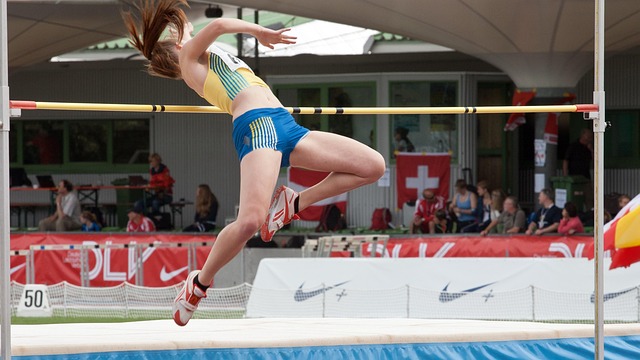
High jump is a track and field event where an athlete attempts to clear a horizontal bar placed between two upright standards. The athlete runs toward the bar, takes off from one foot and passes over it without dislodging it. The bar is raised progressively, so success depends on a combination of speed, jumping power, body control and tactical decisions.
How the high jump works
A competition begins at a selected starting height. Each athlete normally has up to three attempts at every height. An athlete may clear the height, fail, or pass the height without jumping. After all competitors have completed their attempts at that height, the bar is raised according to the competition schedule.
An athlete can continue competing after a failed attempt, but three consecutive failures lead to elimination. The failures do not have to occur at the same height: a miss at one height followed by a pass can still count toward the total sequence of attempts. Competitors may also choose to skip a height, usually to conserve energy or avoid an unsuitable progression.
The winner is the athlete who clears the greatest height. If two or more athletes finish at the same height, officials use the number of failures at that height and then the total number of failures across the competition to separate them. If the result remains tied for first place, a jump-off may be used under the applicable competition rules.
High jump rules
- The athlete must take off from one foot. A two-foot takeoff is not permitted.
- The bar must remain on its supports after the athlete has left the ground and passed over it.
- The athlete must begin the attempt within the competition area and may not deliberately touch the ground or landing area beyond the vertical plane of the bar before clearing it.
- An attempt is a failure if the athlete dislodges the bar, touches the ground beyond the landing area before clearing the bar, or does not complete the attempt within the time allowed.
- The athlete must follow the order set by the officials. Missing the time limit can result in a failed attempt.
The bar is not required to be crossed in a particular body position. Athletes may use any legal technique, provided the takeoff and clearance satisfy the rules. In modern competition, the Fosbury Flop is the dominant method because it allows the athlete to rotate backward and pass over the bar with the body arched.
High jump equipment and area
The high jump area includes a runway, two upright standards, a crossbar and a landing mat. The runway gives the athlete space to build controlled approach speed. The standards hold the crossbar at the selected height, while the landing mat reduces the risk of injury after the athlete falls backward.
The crossbar is supported so that it can fall if contacted. Its length, weight and support design are governed by competition regulations. The standards must be positioned so that the athlete can approach and clear the bar without interference. The landing surface must be suitable for the height and speed of the event, particularly in competitions using the Fosbury Flop.
High jump technique
A successful high jump has four connected phases: the approach, the takeoff, the flight over the bar and the landing.
Approach
The athlete usually follows a curved approach, often beginning with several straighter steps before bending toward the takeoff point. The curve helps create the rotation needed to turn the back toward the bar. The final steps should remain controlled; excessive speed or a poorly placed approach can move the takeoff point too close to or too far from the bar.
Takeoff
The athlete plants the takeoff foot and converts horizontal approach speed into upward movement. The knee and arms drive upward while the body remains tall through the takeoff. The takeoff point is normally outside the standard nearest the approach side, leaving enough space for the athlete to rotate over the bar.
Clearance
In the Fosbury Flop, the athlete turns the back toward the bar, lifts the hips and arches the body over the crossbar. The head and shoulders pass first, followed by the hips and legs. After the hips clear, the athlete raises the legs to reduce the chance of striking the bar.
Landing
The athlete lands on the upper back and shoulders on the landing mat. A controlled landing is part of the technique, not merely the final consequence of the jump. The mat must be large and deep enough to support the landing without requiring the athlete to twist or reach for the surface.
What counts as a failed high jump?
A failed high jump, commonly called a foul or a miss, occurs when the athlete does not legally clear the bar. The most familiar example is knocking the crossbar from its supports. A failure can also occur if the athlete touches the ground or landing area beyond the vertical plane of the bar before clearing it.
Touching the bar does not automatically make an attempt unsuccessful. The attempt counts as a clearance if the bar remains on its supports and no other rule has been broken. Similarly, an athlete may abort an approach before taking off, but the competition time limit and the exact point at which an attempt begins are governed by the event regulations.
How high jump results are decided
Results are recorded by the highest height each athlete successfully clears. The bar is measured from the ground to its upper edge at the centre, where the clearance is most relevant. A height counts only when the officials confirm that the attempt was legal.
For a tie, officials first compare the number of attempts used at the height where the athletes are tied. If necessary, they compare the total number of failures throughout the competition. This means two athletes with the same best height may be ranked differently even if both eventually clear that height.
Common misconceptions about high jump
High jump is not won simply by reaching the greatest vertical height with the body. The athlete needs to raise the body’s centre of mass efficiently and position the body so that it passes over the bar with minimal clearance margin. The arched shape used in the Fosbury Flop can make the body appear to pass lower than the highest point of the athlete’s body.
Another misconception is that athletes must jump from a fixed distance or use a required number of approach steps. Competition rules regulate the legal takeoff and area, but athletes adjust their approach length, curve and starting point to suit their technique, speed and rhythm.
Why technique and tactics matter
Power alone does not determine a high jump result. An athlete may choose to pass a height, change the approach rhythm, or preserve attempts for later heights. A technically consistent athlete can sometimes outperform a more powerful jumper by reducing missed attempts and maintaining reliable takeoff positions.
Conditions also matter. Wind, a slippery runway, fatigue and changes in rhythm can affect the approach and takeoff. Athletes therefore balance ambition with consistency: attempting a height that is too aggressive may cost attempts, while conservative decisions can leave too much ground to recover later in the competition.